By MDA Staff Writer | October 20, 2026
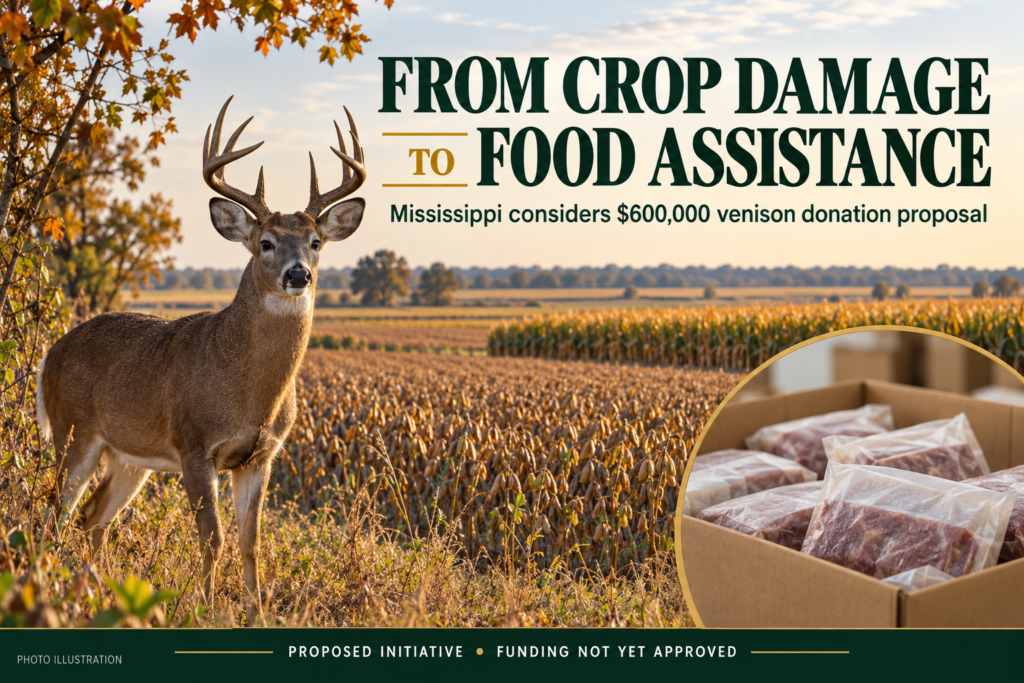
JACKSON, Miss. — Deer that damage Mississippi crops could help feed families under a proposed initiative that would expand the capacity to process donated venison for charitable distribution.
According to reporting by The Mississippi Wire, representatives of the Mississippi Department of Wildlife, Fisheries, and Parks discussed the proposal during an October 14 legislative committee hearing. Officials outlined approximately $600,000 in startup funding for equipment and processing facilities.
The proposal comes as farmers contend with significant losses from deer feeding in agricultural fields.
A 2025 producer survey conducted by Mississippi State University researchers documented damage to approximately 17,830 acres of corn, cotton and soybeans, with an estimated economic impact of $4.6 million, according to MSU Extension.
The findings reflect losses reported by survey participants rather than a complete statewide accounting. Respondents indicated that actual losses were higher.
For the Mississippi Delta, where row-crop production supports local businesses and livelihoods, those losses underscore the economic importance of managing deer populations.
The proposed donation initiative would connect wildlife management with hunger relief by creating a way to process donated deer meat for distribution through charitable organizations.
The Mississippi Wire identified William McKinley, a state deer program official, as discussing startup costs during the hearing. Potential funding partnerships involving Accelerate Mississippi and the Mississippi Soybean Promotion Board also were discussed.
The proposal remains a funding request. It should not be confused with an approved appropriation or an operating program.
Implementation would require decisions about processing locations, participation, food safety and distribution. The supplied reporting does not identify participating Mississippi Delta processors or food banks.
MSU Extension wildlife specialist Jacob Dykes has described an overabundance of deer in many parts of Mississippi and declining harvest levels as challenges for farmers and wildlife managers. In an August report, Extension cited an estimated statewide population of 1.75 million deer.
Dykes also emphasized the role hunters and landowners can play in keeping deer numbers at levels that reduce agricultural damage.
For Delta communities, the donation proposal offers a potential connection between protecting crops and helping households obtain food. Whether it delivers those benefits will depend on funding, processing capacity and participation.
________
Source: Mississippi Department of Wildlife, Fisheries, and Parks — Deer Program and Mississippi State University Extension — Deer Damage Survey